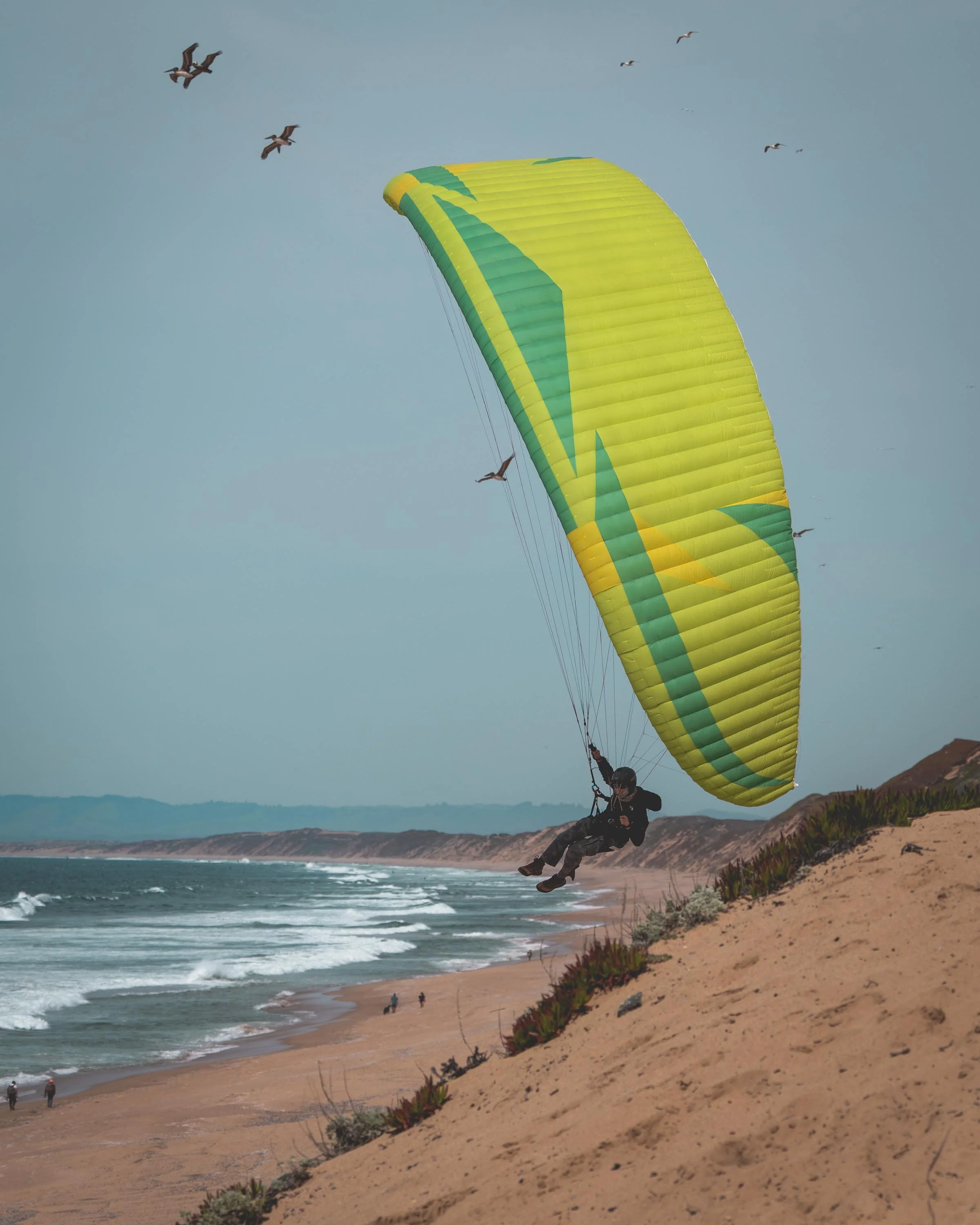
TrimTuning Your Parakite
Let’s talk about something gloriously unsexy and wildly important: retrimming your parakite.
Because nothing humbles a pilot faster than realizing the wing didn’t get slow… you did. Or more accurately, your trim did.
Many pilots are quietly noticing across manufacturers: parakites are going out of trim faster than we’d like. Not because they’re junk. Not because Dyneema is secretly spaghetti. But because physics is patient and load paths don’t lie.
Dyneema — that miracle fiber — is absurdly strong. It has extremely low elastic stretch. People hear that and think “bulletproof.” But here’s the nerdy truth: the fibers themselves barely elongate, yet the braided weave absolutely does settle under load. The structure moves. The geometry changes. And in parakites, geometry is everything.
Now consider where the majority of load flows through the system. It’s not evenly distributed fairy dust. Most of the stress runs through the A connection points into your carabiners. That’s the primary load path. So when things begin to creep, that’s where you’ll see the biggest discrepancy from factory length.
After as little as 20 hours — especially if you’re flying aggressively and loading the wing hard — you can start to see changes. By 50–100 hours, many pilots notice a substantial reduction in speed and something visually obvious: a crease across the reflex section when hands are fully up.
A healthy reflex profile has a smooth, continuous transition from D lines to trailing edge. When the trim shifts, you’ll see a demarcation line — a crease across the back of the wing. That’s geometry telling you it’s not happy.
Now, are the risers “stretching”? Sort of. But not in the way people imagine. This isn’t bungee cord behavior. It’s micro-settling. Creep. Knot compression. Fiber bedding-in. The Dyneema filaments don’t elongate much, but the braid tightens. The A riser knot cinches down under repeated load cycles. Tiny changes add up to measurable differences.
And a few millimeters in the A’s can dramatically alter angle of attack and reflex behavior.
Here’s the practical interim fix: add a loop at the A riser connection point to the maillon (hard link).
Not a simple overhand knot tied in the riser body — that creates a stress concentration and weak point in the fibers. Instead, a proper loop configuration that shortens the effective A length without compromising structural integrity. You can also add corresponding loops at the A line connections if you need more taken in.
Relining should be the last drastic step and typically shouldn’t be necessary for many, many hours or unless there’s damage. Most slow-down issues pilots are feeling are geometry drift, not catastrophic line stretch.
The key shift here is mindset. Stop thinking of trim as fixed. It’s dynamic. Every heavy loading, every hard inflation, every high-G carve is quietly persuading your weave to settle.
Wings are mechanical systems. Mechanical systems drift.
The good news? This is measurable. Fixable. Teachable.
The strange, delightful truth is this: your wing is constantly negotiating with gravity. Retrimming is just stepping back into the conversation.
When geometry is right, reflex is clean, speed returns, and that crease disappears.